
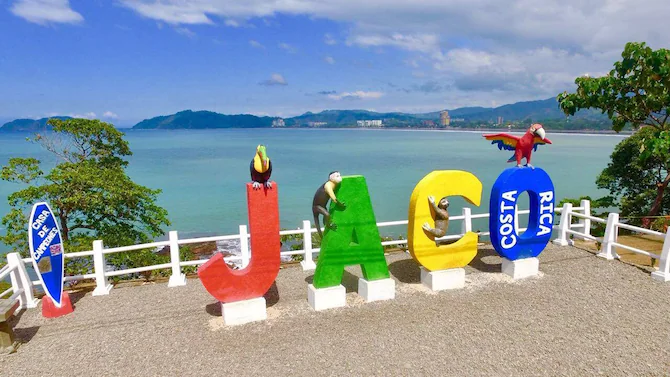
Jacó, Costa Rica — site of the four-night infidelity surveillance operation documented in this case study.
Not every infidelity surveillance case confirms what the client fears. This one did not. Cody L. Gear and Associates was retained by our client from New York City — Manhattan — to conduct surveillance in Jacó, Costa Rica on their partner during a charter boat fishing trip. The client had specific concerns and specific names — individuals they believed their partner might be meeting while ostensibly on a fishing trip. Four nights of close surveillance in Jacó, Costa Rica produced a record that contradicted those suspicions entirely.
We document that outcome here for the same reason we document any other: because the value of professional investigation is not in confirming what a client hopes to find. It is in delivering an objective record of what actually happened — whatever that turns out to be.
Pre-Surveillance Preparation
The client provided detailed pre-surveillance information before the operation began — arrival dates, hotel information, and photographs of specific individuals they wanted monitored for association. The cover for the trip was a charter boat fishing excursion, which is one of the most common pretexts for solo travel to Jacó — a Pacific coast town with a well-established sport fishing industry operating out of its marina. That framing told us something useful: the subject's days would likely be structured around the boats, with evenings free to move through the town independently. Surveillance in Jacó, Costa Rica requires understanding that rhythm — the town changes completely after dark, and the operational approach has to change with it.
Working in coordination with our network partners at Privin Network on pre-surveillance planning, we mapped the subject's likely evening movements through Jacó's central corridor — Hotel Jacó, Hotel Croc's, the Blue Marlin, and the surrounding nightlife district — and established mobile vantage points on both foot and vehicle before the subject's first night of independent activity.
Surveillance Log
Night One — May 5, 2025
The subject returned from the day's charter fishing activity in the late afternoon and moved into the central Jacó corridor during the evening. Our team maintained continuous coverage through mobile surveillance on foot and by vehicle as the subject visited multiple bars and clubs including the Blue Marlin Lounge and venues in the Bairro Alto area.
The subject remained largely alone or engaged in brief, surface-level social interactions throughout the night. He was not observed with any of the individuals the client had specifically flagged in the pre-surveillance briefing. He returned to his hotel alone in the early morning hours.
Night Two — May 6, 2025
Another day on the water. The subject dined alone at a nearby restaurant earlier in the evening before returning to the nightlife district and revisiting several of the same venues from the previous night. No flirtatious or intimate contact was observed. The subject returned to his hotel alone at approximately 6:50 a.m. The pattern from Night One held — the same venues, the same independent movement, no contact with the flagged individuals.
Night Three — May 7, 2025
The subject followed the same general pattern — evening movement through the central corridor, social interaction in public venues that did not progress beyond surface level, no observed contact with the individuals the client had identified as concerns. Coverage was maintained through the night. The subject returned to his hotel alone.
Night Four — May 8, 2025
Final night of the operation and the last night of the charter fishing trip. Surveillance maintained through the full evening. The subject's pattern held across all four nights — the same venues, the same independent movement, no contact with the flagged individuals, no conduct inconsistent with the stated purpose of the trip. Four consecutive nights produced a consistent and unambiguous record.
Findings and Outcome
Over four consecutive nights of surveillance, no romantic interaction or conduct consistent with infidelity was observed. The subject visited multiple social venues each night but did not engage in behavior that would indicate the kind of activity the client suspected. He was never in the company of the specific individuals identified in the pre-surveillance briefing across any of the three operational nights.
The complete report — timestamped video footage, photographic documentation, and detailed field logs — was delivered to the client as a full objective record of the subject's activities over the operational period.
"Not every case ends with confirmation of what the client feared. This one ended with something more useful: a documented record that the concerns were not substantiated. That is not a failed investigation. That is the investigation working exactly as it should."
Peace of mind backed by objective documentation is a legitimate and valuable outcome. A client who suspects their partner and never finds out — who spends years wondering — carries a different kind of burden than one who has a professional record showing what actually occurred. This case provided that clarity. The client's concerns were not confirmed. They had the documentation to support that conclusion rather than simply being asked to take someone's word for it.
Frequently Asked Questions
Can a U.S.-based client hire a private investigator in Costa Rica?
Yes — and this is one of the most common client profiles we work with. Most of our infidelity surveillance clients are based in the United States and their partners are traveling to Costa Rica. The entire engagement can be handled remotely from the client's side — they provide the information we need before the operation begins, and we deliver the completed report when the work is done. The client in this case never left the United States.
Is it legal to conduct surveillance in Costa Rica or record someone in public?
Yes — when conducted from public-access locations by a qualified investigator. Observation and documentation of an individual's activities in public spaces is fully lawful in Costa Rica and does not require the subject's consent. Every operation we run is structured to stay within the legal parameters of both Costa Rican law and U.S. evidentiary standards. I have been conducting this type of work in Costa Rica for 27 years and I know precisely where the legal lines are.
What kind of evidence can I expect from a surveillance operation?
A complete case report including edited and raw video footage, an indexed photographic gallery, and detailed field logs with timestamped location data. Everything is organized and formatted for direct use by legal counsel if the situation proceeds to formal proceedings — or for personal decision-making if the client's situation remains private. The report documents what was observed, when, and where — and is equally useful whether it confirms the client's concerns or, as in this case, does not.
Will the subject know they are being followed?
No. Surveillance is conducted discreetly using mobile vantage points and high-resolution zoom equipment that allows us to document from a distance that keeps our presence undetected. In Jacó specifically, we know the geography, the lighting conditions, the traffic patterns, and the specific dynamics of the nightlife corridor well enough to maintain coverage without any proximity that would register. The subject in this case had no awareness of the operation across either night of coverage.
What if the subject changes plans mid-operation?
We adapt. Mobile surveillance is designed precisely for this — our team follows the subject's actual movements rather than holding fixed positions. If a subject moves to an unexpected location, changes venues, or alters their itinerary, the operation moves with them. This is standard field procedure, and it is why local familiarity with the operational area matters as much as equipment and technique.
Can I request that specific individuals be watched for association with the subject?
Yes. Clients who provide photographs and identifying information for specific individuals of concern allow us to build a more targeted operational brief before we begin. In this case, the client provided photographs of several individuals they suspected their partner might be meeting. Part of the operational finding was that the subject was never in the company of any of those individuals across four nights of coverage — a conclusion that would not have been possible to document without that advance information.
How do you report back to clients during an international surveillance operation?
Communication during an active operation is managed carefully to avoid compromising the surveillance. We provide status updates at agreed intervals — typically after each operational day — and deliver the full report with all documentation upon completion. Clients are never left without contact, but real-time commentary during active fieldwork is not standard practice, as it introduces distraction and potential security risk to the operation.
Case documented by Cody L. Gear, CFE · Jacó, Costa Rica · May 2025 · Updated April 2026. All identifying details have been modified to protect client and subject confidentiality.
